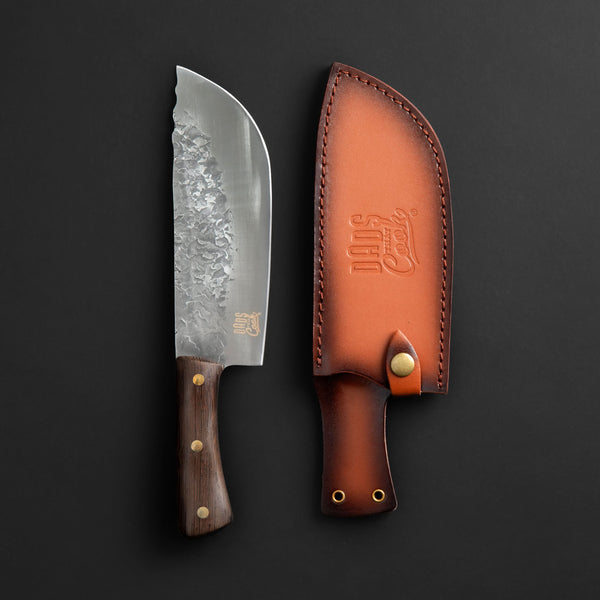
A chef knife versus santoku matchup is not about finding one blade that humiliates the other. It is about knowing what belongs in your hand when the cutting board is loaded: onions for burgers, herbs for chimichurri, chicken for a weeknight stir-fry, or a roast that needs clean, confident slices. Both knives can carry dinner. They just take different routes to the finish line.
For the dad who likes to cook with purpose, the chef knife is usually the workhorse. The santoku is the quick, precise specialist. Know the difference, and you will spend less time fighting your prep and more time serving food worth gathering around for.
Chef Knife Versus Santoku: The Blade Difference
A classic Western chef knife has a broad blade that curves upward toward the tip. Most home versions run between 7 and 10 inches, with an 8-inch blade often considered the all-around standard. That curve is built for a rocking motion: the front of the blade stays near the board while the heel rises and falls through the food.
A santoku is a Japanese-style multipurpose knife, commonly about 5 to 7 inches long. Its blade is flatter along the cutting edge, wider from spine to edge, and rounded or angled down at the tip. Santoku translates roughly to “three virtues,” often understood as slicing, dicing, and mincing. It is designed for clean, straight-down cuts and a forward chopping motion rather than a big rock on the board.
That difference sounds small until you start moving through a pile of vegetables. A chef knife wants room to swing. A santoku wants you to keep the blade more level and controlled. Neither method is superior across every job. Your ingredients, board space, hand size, and habits all matter.
Why the chef knife feels bigger and stronger
The extra length of a chef knife gives you reach. It can cut through a large cabbage, split a butternut squash with care, break down a pile of potatoes, or slice a thick steak after it has rested. Its pointed tip also gives you more control for detailed jobs, such as trimming silver skin from a tenderloin or working around the core of a tomato.
The blade height does serious work, too. After chopping garlic, you can scoop it straight into the pan. After dicing onions, you can move a full load without making three trips. A full-tang 7.5-inch chef knife, like the one from Dads That Cook, lands in a useful sweet spot: enough blade for real prep, without feeling like you brought a sword to taco night.
Why the santoku feels fast and nimble
A santoku is often lighter and shorter, which can make it less intimidating for newer cooks and less tiring during a long vegetable-prep session. The flatter edge encourages crisp, deliberate cuts. If your usual move is lifting the blade and bringing it straight down, the santoku may feel natural immediately.
Many santokus have shallow dimples along the side of the blade, called grantons. They can reduce sticking when slicing foods like cucumbers, potatoes, or boneless chicken. They are helpful, but not magic. Wet food still sticks to steel sometimes. A sharp edge and solid technique matter more than dimples ever will.
Choose a Chef Knife When Dinner Gets Serious
A chef knife is the better primary knife for most dads building a capable kitchen. It has the range to handle the jobs that turn cooking from an idea into a meal.
Reach for it when you are dealing with larger ingredients, thicker proteins, or prep that calls for a pointed tip. It shines when you are chopping mirepoix for chili, cutting peppers and onions for fajitas, mincing a mountain of herbs, or slicing a tri-tip against the grain. The curved belly makes repetitive rocking cuts efficient once you learn the rhythm.
It also earns its spot if you cook meat often. A chef knife will not replace a boning knife for separating joints or a cleaver for heavy-duty butchery, but it gives you more control around raw chicken, pork chops, and boneless roasts than a shorter santoku usually can. When the meal is built around protein, reach is an advantage.
The trade-off is that a chef knife can feel bulky in a cramped kitchen or in smaller hands. If you force a rock-chop with poor wrist position, the extra length becomes a liability. Keep the tip close to the board, guide the blade with your knuckles, and let the sharp edge do the work. Muscle is great at the grill. Precision wins at the cutting board.
Choose a Santoku for Quick, Clean Prep
The santoku comes alive when vegetables are the main event or when you want a compact knife that moves quickly. Think stir-fry night, sheet-pan vegetables, chopped salad, salsa, or a pile of produce for meal prep. Its broad blade gives you a good surface for transferring ingredients, while the flatter edge makes uniform slices easy to repeat.
It is especially good for cooks who prefer a push cut. Instead of rocking the knife in a wide arc, you move the edge forward and down through the food, then lift and reset. That technique makes clean work of carrots, celery, zucchini, mushrooms, and boneless cuts of chicken.
A santoku is also a smart second knife for a household where more than one person cooks. Maybe you want the chef knife for brisket-trimming duty while your partner chops vegetables beside you. Maybe a teenager is learning knife skills and feels more comfortable with a shorter blade. A good kitchen does not need duplicate tools. It needs tools with clear jobs.
The limitation is versatility at the extremes. A santoku can slice a large watermelon or tackle a dense squash, but it is not always the most comfortable or controlled choice. Its less pronounced tip can also make intricate trimming harder. If you only own one serious knife, that matters.
The Real Decision: Your Cooking Style
Do you cook big family meals, grill often, and prep proteins alongside vegetables? Start with a chef knife. It is the blade that can stay on the board from the first onion to the final steak slice.
Do you cook mostly vegetables, favor straight chopping, or want a lighter knife for fast weekday prep? A santoku may be the blade you grab more often. There is no bonus point for owning the knife that looks most professional if it does not fit the way you move.
Grip tells part of the story. Cooks using a pinch grip, with thumb and forefinger gripping the blade near the handle, often appreciate the balance and curve of a chef knife. Cooks who hold mostly at the handle may find a santoku’s shorter, flatter shape easier to control. Try mimicking your usual prep motion before you buy. The knife should feel like an extension of your hand, not a tool you have to negotiate with.
Sharpness Beats Blade Arguments
Here is the truth nobody wants to hear while shopping for shiny new gear: a dull chef knife loses to a sharp santoku, and a dull santoku loses to a sharp chef knife. Edge maintenance changes everything.
A sharp blade bites into tomato skin instead of crushing it. It cuts onions cleanly instead of tearing them apart. It requires less force, which means your hand has more control and is less likely to slip. Hone the edge regularly if your knife calls for it, and sharpen it when slicing starts to feel like work.
Use a stable cutting board, not a plate or countertop. Avoid tossing good knives into a drawer where they bang into other utensils. Hand-wash, dry right away, and store the blade so the edge stays protected. Take care of the tool, and it will keep showing up for every burger night, birthday breakfast, and Sunday dinner.
Make the Knife Earn Its Keep
If you want one knife that can handle nearly anything your family throws at you, choose the chef knife and learn its rocking motion. If your kitchen is already covered for larger jobs or you want a lighter vegetable-prep machine, add a santoku.
Better yet, stop treating the choice like a permanent draft pick. Build the setup your cooking deserves. Put a sharp chef knife in your hand for the heavy lifting, bring out the santoku when speed and clean vegetable cuts call your name, and get dinner on the table like you meant it.