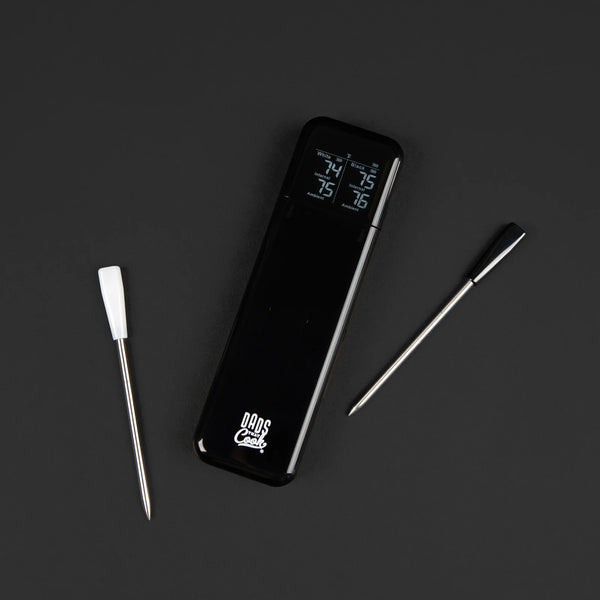
That brisket does not care how confident you felt when you lit the charcoal. It cares about temperature. A good wireless thermometer review should cut past flashy app screens and huge range claims to answer one question: can this tool help you pull meat at the right moment, every time?
For dads running the grill while also setting the table, helping with homework, or talking trash during the game, wireless monitoring is a real advantage. You can watch the cook without hovering over the smoker for eight hours. But not every wireless thermometer deserves space in your barbecue setup. The best one depends on what you cook, how far you roam, and whether you want a simple alert system or command-center-level control.
What a Wireless Thermometer Must Do Well
A wireless thermometer has one job above all else: deliver trustworthy temperatures when the stakes are high. A few degrees can be the difference between juicy chicken and dry chicken, tender pork and a roast that fights back, or a steak with a perfect rosy center and one that went too far.
Accuracy comes first. Look for a thermometer that reads consistently and gives you confidence in both the internal meat temperature and, when included, the ambient temperature inside the grill or smoker. A probe can be loaded with smart features, but if its reading drifts, the rest is decoration.
Response time matters too, especially for cooks with changing heat. A smoker may move slowly, but a reverse-seared ribeye can jump from perfect to overdone in a hurry. The app should refresh temperatures quickly enough for you to make a decision before dinner gets away from you.
Then there is the connection. Some systems use Bluetooth, while others connect through Wi-Fi. Bluetooth models are often simpler and can work well for a backyard cook where your phone stays nearby. Their stated range may sound impressive, but walls, siding, grills, and distance can shrink that number fast. Wi-Fi systems give you more freedom because you can check your cook from inside the house or while making a quick store run, as long as your home network is reliable.
Neither option automatically wins. Bluetooth is often the right call for straightforward grilling. Wi-Fi earns its keep for long overnight cooks, big gatherings, and dads who want to monitor a pork shoulder without standing guard all afternoon.
Wireless Thermometer Review: The Features Worth Paying For
A great wireless thermometer feels like a second set of eyes at the grill. A frustrating one creates more work than it saves. When comparing models, focus on the features that change how you cook.
Probe count and probe design
One probe is enough for a weeknight chicken breast or a couple of steaks. It is not enough when you are smoking a brisket, cooking two pork butts, and tracking the pit temperature at the same time. For serious barbecue, two to four probes give you breathing room.
Pay attention to the probe itself. A thin probe leaves a smaller hole in a steak and generally responds faster. A thicker probe may feel tougher, but it can be awkward in smaller cuts. The cable matters as much as the metal tip. Cheap cables can become the weak point around hot grill grates, flare-ups, and repeated use.
Some newer wireless probes have no external cable at all. They sit inside the meat and transmit to a charging block, receiver, or phone. That design is clean and convenient, especially for rotisserie cooking. The trade-off is battery management and signal reliability. Thick grill lids, metal smokers, and dense cuts of meat can sometimes interfere with a connection.
Useful alerts, not constant noise
Temperature alarms are the reason to buy a wireless model. Set a target temperature, step away, and return when the meat is ready. That is the promise.
The best apps let you set high and low ambient alarms as well. This is a major advantage during low-and-slow cooking. If your smoker drops below your target range, you can add fuel or adjust airflow before the bark stalls and the timeline gets wrecked. If the pit spikes, you can catch the problem before a sugary rub burns.
Avoid an app that buries basic controls beneath too many screens. You should be able to see the current temperature, target temperature, estimated finish time, and connection status at a glance. Smart presets for brisket, ribs, chicken, and steak are helpful starting points, but they should not replace common sense. Every cut, grill, and fire behaves differently.
Battery life and charging reality
For burgers, almost any charged thermometer can make it through the cook. For an overnight brisket, battery life stops being a spec-sheet detail and becomes the whole game.
Check whether the transmitter, charging block, and probes need separate charging. Consider how long a fully charged system lasts while actively connected. A unit that needs frequent attention is not truly wireless freedom. It is one more thing to babysit.
Charging cases are handy, particularly for cable-free probes, but only if they are easy to keep charged and easy to clean. Grease, smoke, and wet hands are normal around barbecue. Your gear should handle the real cook, not just look sharp on a countertop.
How We Judge Range in the Real World
Manufacturers love to advertise range in open air. Your backyard is not open air. You have walls, a refrigerator, patio furniture, a metal grill lid, and probably a phone tucked into a pocket or resting on a kitchen counter.
Treat range claims as a best-case scenario. Before committing to an all-day cook, test your thermometer while moving through the spaces you actually use. Walk inside. Check the living room. Go upstairs. See whether the app reconnects quickly if the signal drops.
Connection recovery is a hidden difference-maker. A brief disconnect should not turn into a full reset or leave you wondering whether the temperature data is still current. A reliable system tells you when it loses contact and reconnects without drama.
If you cook in an apartment, on a compact patio, or within a few steps of the grill, Bluetooth can be plenty. If your smoker lives at the edge of a large yard, Wi-Fi or a receiver-based system is usually the stronger play.
The Trade-Offs Nobody Mentions Until Cook Day
Wireless thermometers are powerful, but they do not replace an instant-read thermometer. A leave-in probe tracks the center of a roast over time. An instant-read thermometer helps you check multiple spots, confirm doneness near a bone, and verify the final result before slicing.
That matters because meat is not perfectly uniform. The thickest point may be ready while another section needs more time. A brisket can be temperature-ready yet still need tenderness checks. A steak can hit its target in the center but need a final sear for the crust your family expects.
For that reason, a wireless unit and a fast digital instant-read thermometer make a strong team. One watches the cook. The other settles the question when it is time to serve.
Cleaning is another trade-off. Probes and cables need attention after every use. Do not soak electronic transmitters unless the manufacturer specifically says they are waterproof. Wipe down probes, inspect cable insulation, and store everything dry. The dad who takes care of his tools gets more seasons out of them.
Which Wireless Thermometer Fits Your Cook?
The right choice starts with your most common cook, not the most ambitious one on your wish list.
If you mainly grill steaks, chicken, chops, and burgers, prioritize quick setup, a dependable single probe, and a clear app. You do not need a dozen graphs to cook a great dinner on a Tuesday.
If you smoke ribs, pork shoulder, turkey, or brisket, choose multiple probes, ambient temperature tracking, long battery life, and alarms you can hear from inside the house. This is where a better system earns its price. It lets you host the crew, play catch with the kids, or prep sides without losing control of the fire.
If you are buying a gift for a dad who takes barbecue seriously, think beyond the packaging. The best gift is the one he will use every weekend: durable probes, a simple interface, and enough range for his actual setup. Fancy features are a bonus. Dependable temperatures are the win.
Put the Thermometer to Work
Place the probe in the thickest part of the meat, away from bone and big pockets of fat. For long cooks, route any cables away from direct flame and avoid pinching them under a heavy lid. Set your target temperature before the cook gets busy, then set an ambient high and low alert if your thermometer supports it.
Most of all, use the alerts as a prompt to check the food, not as permission to stop paying attention. Rest times, carryover cooking, bark, tenderness, and heat control still belong to the cook. The thermometer gives you the data. You bring the judgment.
Build that habit, and the grill becomes less stressful and more fun. You get to spend less time guessing, more time feeding your people, and more time serving the kind of meal that makes everybody ask when you are cooking again.